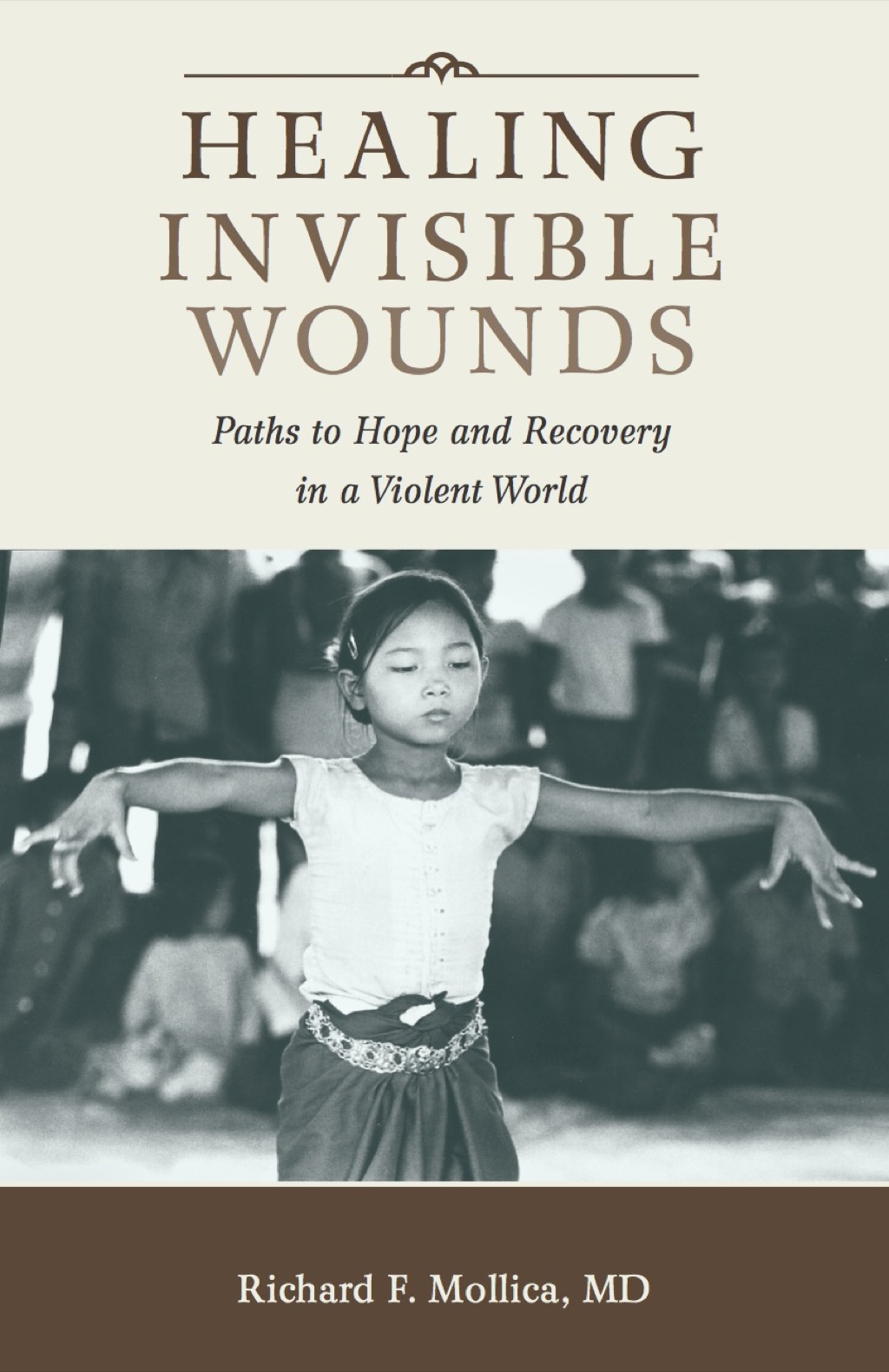

In these personal reflections on his thirty years of clinical work with victims of genocide, torture, and abuse in the United States, Cambodia, Bosnia, and other parts of the world, Richard Mollica describes the surprising capacity of traumatized people to heal themselves. Here is how Neil Boothby, Director of the Program on Forced Migration and Health at the Mailman School of Public Health, Columbia University, describes the book: “Mollica provides a wealth of ethnographic and clinical evidence that suggests the human capacity to heal is innate–that the ‘survival instinct’ extends beyond the physical to include the psychological as well. He enables us to see how recovery from ‘traumatic life events’ needs to be viewed primarily as a ‘mystery’ to be listened to and explored, rather than solely as a ‘problem’ to be identified and solved. Healing involves a quest for meaning–with all of its emotional, cultural, religious, spiritual and existential attendants–even when bio-chemical reactions are also operative.” Healing Invisible Wounds reveals how trauma survivors, through the telling of their stories, teach all of us how to deal with the tragic events of everyday life. Mollica’s important discovery that humiliation–an instrument of violence that also leads to anger and despair–can be transformed through his therapeutic project into solace and redemption is a remarkable new contribution to survivors and clinicians. This book reveals how in every society we have to move away from viewing trauma survivors as “broken people” and “outcasts” to seeing them as courageous people actively contributing to larger social goals. When violence occurs, there is damage not only to individuals but to entire societies, and to the world. Through the journey of self-healing that survivors make, they enable the rest of us not only as individuals but as entire communities to recover from injury in a violent world.
Healing Invisible Wounds: Paths to Hope and Recovery in a Violent World is written by Richard F. Mollica and published by Vanderbilt University Press. The Digital and eTextbook ISBNs for Healing Invisible Wounds are 9780826516428, 0826516424 and the print ISBNs are 9780826516411, 0826516416


Breaking the Bamboo Ceiling
Diplomacy in a Globalizing World
A Guide to Six Sigma and Process Improvement for Practitioners and Students
Concerto in G Major: For Flute and Piano
Bayesian Statistics for the Social Sciences
An Introduction to Psychological Assessment and Psychometrics
Building a StoryBrand
Developmental Mathematics: Prealgebra, Beginning Algebra, & Intermediate Algebra
Elementary Stochastic Calculus, with Finance in View
A Gentle Path through the Twelve Steps
American Government and Politics Today: Essentials 2017-2018 Edition
First Course in Probability, A
A Ditch in Time
Beyond Combat
Budgeting and Financial Management for National Defense
Caffaro, Genoa and the Twelfth-Century Crusades
Mathematics for Machine Technology
Attacking Faulty Reasoning
Exploring Moral Problems
Mathematics for the Liberal Arts
Loving Someone with PTSD
Disentangling Consciencism
Growing a Sustainable City? 
Review Healing Invisible Wounds
There are no reviews yet.