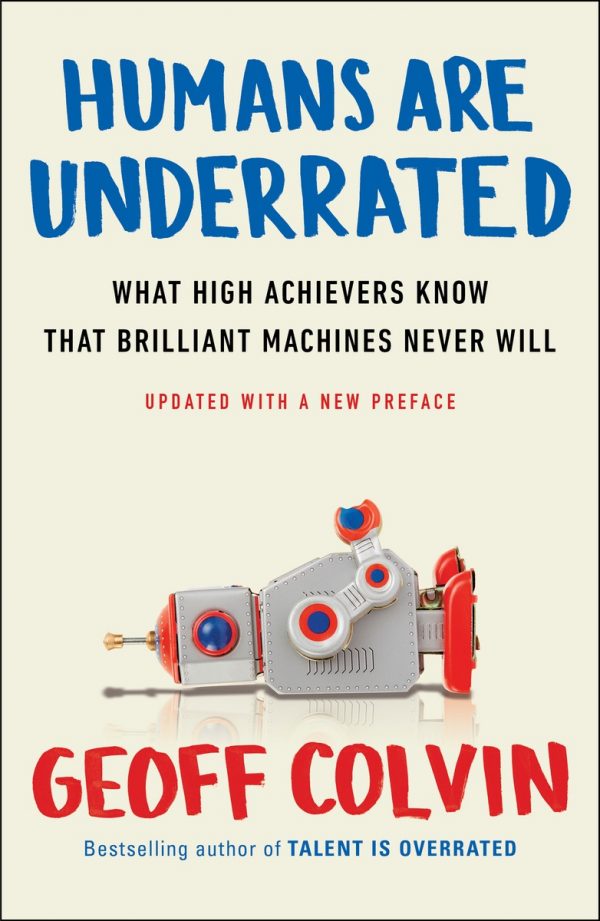

As technology races ahead, what will people do better than computers? What hope will there be for us when computers can drive cars better than humans, predict Supreme Court decisions better than legal experts, identify faces, scurry helpfully around offices and factories, even perform some surgeries, all faster, more reliably, and less expensively than people? Its easy to imagine a nightmare scenario in which computers simply take over most of the tasks that people now get paid to do. While well still need high-level decision makers and computer developers, those tasks wont keep most working-age people employed or allow their living standard to rise. The unavoidable questionwill millions of people lose out, unable to best the machine?is increasingly dominating business, education, economics, and policy. The bestselling author of Talent Is Overrated explains how the skills the economy values are changing in historic ways. The abilities that will prove most essential to our success are no longer the technical, classroom-taught left-brain skills that economic advances have demanded from workers in the past. Instead, our greatest advantage lies in what we humans are most powerfully driven to do for and with one another, arising from our deepest, most essentially human abilitiesempathy, creativity, social sensitivity, storytelling, humor, building relationships, and expressing ourselves with greater power than logic can ever achieve. This is how we create durable value that is not easily replicated by technologybecause were hardwired to want it from humans. These high-value skills create tremendous competitive advantagemore devoted customers, stronger cultures, breakthrough ideas, and more effective teams. And while many of us regard these abilities as innate traitshes a real people person, shes naturally creativeit turns out they can all be developed. Theyre already being developed in a range of far-sighted organizations, such as: the Cleveland Clinic, which emphasizes empathy training of doctors and all employees to improve patient outcomes and lower medical costs; the U.S. Army, which has revolutionized its training to focus on human interaction, leading to stronger teams and greater success in real-world missions; Stanford Business School, which has overhauled its curriculum to teach interpersonal skills through human-to-human experiences. As technology advances, we shouldnt focus on beating computers at what they dowell lose that contest. Instead, we must develop our most essential human abilities and teach our kids to value not just technology but also the richness of interpersonal experience. They will be the most valuable people in our world because of it. Colvin proves that to a far greater degree than most of us ever imagined, we already have what it takes to be great.
Additional ISBNs: 9781591847205, 1591847206, 9780698153653, 0698153650


Applied Statistics Using Stata: A Guide for the Social Sciences
Art Therapy Theories
A Redbird Christmas
Administrator's Guide to School-Community Relations, The
A Lamp Unto My Feet
Bad Girls of the Bible
Bound for Glory
Certification Review for Nurse Anesthesia
Brush of Wings
A Popular Survey of the New Testament
The Unnameable Monster in Literature and Film
Last Child in the Woods
A Woman's Guide to Cannabis
Sand Opera
Barracoon
Essentials of Geology
Harvard Business Review on Managing Supply Chains
Aquinas on Being, Goodness, and God
Assessment in Special and Inclusive Education
Learn to Crochet Granny Squares and Flower Motifs
McGraw-Hill Education: 10 ACT Practice Tests, Fifth Edition
College Physics 2nd
Career Guide in Criminal Justice
Icelandic Magic
Experiments in General Chemistry: Featuring MeasureNet
Basic Concepts of Intercultural Communication
Business Communication 
Review Humans Are Underrated
There are no reviews yet.